NIFASE
Job Oriented Course

INVESTMENT ANALYST & PORTFOLIO MANAGEMENT PROGRAM

Instructor: NIFASE Faculty
14,990 already enrolled
Included with NIFASE Institute
12 modules
Module-wise syllabus
4.6
(740 reviews)
Professional Program
Level
Flexible schedule
Learn at your own pace
96%
Learners liked this course

A program for aspiring investment analysts covering financial statement analysis, research framework, valuation logic (conceptual), portfolio construction basics, performance review, and professional reporting.

Skills you'll gain

Analyst MindsetFinancial StatementsIndustry ResearchValuation LogicEquity Research ProcessPortfolio BasicsPerformance ReviewProfessional Reporting

See where our learners get hired

Roles across brokerages, banks, research desks, and fintech.

Hiring / Placement support

Modules

Module 1: Role of an Investment Analyst
  • What investment analysts do
  • Buy-side vs sell-side overview
  • Analyst vs trader vs advisor mindset
  • Ethical responsibilities (conceptual)
Module 2: Financial Statement Analysis
  • Income statement, balance sheet & cash flow (analyst view)
  • Revenue, profitability & cash flow analysis
  • Understanding financial quality
  • Red flags in financials
Module 3: Business & Industry Analysis
  • Business model evaluation
  • Competitive advantage concepts
  • Industry structure & cycles
  • Sector-level analysis
Module 4: Valuation Fundamentals (Conceptual)
  • Purpose of valuation
  • Relative vs absolute valuation (overview)
  • Valuation limitations
  • Analyst judgment vs numbers
  • Focus on logic, not complex math
Module 5: Equity Research Framework
  • Research process & documentation
  • Qualitative vs quantitative analysis
  • Building an investment thesis
  • Monitoring & review mindset
Module 6: Portfolio Management Basics
  • Portfolio construction logic
  • Diversification principles
  • Risk-return trade-off
  • Portfolio rebalancing basics
Module 7: Asset Allocation & Risk Management
  • Strategic asset allocation
  • Portfolio risk measurement (conceptual)
  • Drawdown & volatility awareness
  • Capital preservation mindset
Module 8: Performance Measurement & Review
  • Portfolio performance evaluation
  • Benchmarking concepts
  • Attribution analysis (intro level)
  • Learning from outcomes
Module 9: Case Studies & Practical Analysis
  • Equity & portfolio case studies
  • Market cycle-based decisions
  • Portfolio adjustment scenarios
  • Analyst decision review
Module 10: Analyst Communication & Reporting
  • Presenting investment ideas
  • Writing basic research notes
  • Explaining portfolio decisions
  • Professional communication standards
Module 11: Ethics, Compliance & Limitations
  • Ethical decision-making
  • Conflict of interest awareness
  • Responsible analysis practices
  • Professional integrity mindset
Module 12: Career Roadmap & Next Steps
  • Analyst & PM career paths
  • Skill roadmap (advanced finance, certifications)
  • Continuous learning approach
  • Transition to higher roles

Explore Courses

Top programs with the longest duration.

PopularAdvance Diploma in Financial Market Management (ADFMM)
Advance Diploma12 Months
Job Oriented Course

Advance Diploma in Financial Market Management (ADFMM)

A comprehensive, career-focused program spanning trading, derivatives, commodities, advanced technical + fundamental analysis, and market operations.

  • Understanding financial markets
  • Basic knowledge of the capital market (Primary Market & Secondary Market)
  • Market participants
10 modules
View Details
PopularADVANCE DIPLOMA IN STOCK MARKET
Advance Diploma12 Months
Job Oriented Course

ADVANCE DIPLOMA IN STOCK MARKET

A 12-month advanced diploma structured in phases: market foundations, equity/technical mastery, derivatives/options, fundamentals/macro, systematic tracks (algo/portfolio), and professional career prep.

  • Capital Market Fundamentals (NSE, BSE, SEBI ecosystem)
  • Financial instruments overview
  • Market participants & structure
6 modules
View Details
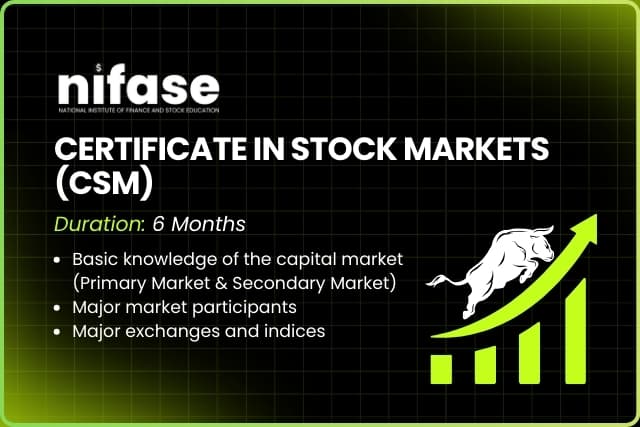
PopularCertificate in Stock Markets (CSM)
Certificate6 Months
Job Oriented Course

Certificate in Stock Markets (CSM)

A practical + theory program covering capital markets, derivatives, and technical analysis.

  • Basic knowledge of the capital market (Primary Market & Secondary Market)
  • Major market participants
  • Major exchanges and indices
3 modules
View Details

FAQ

Frequently Asked Questions

A quick rundown of how NIFASE works so you can focus on trading, not decoding terms and conditions.

A share market course at NIFASE is a structured learning program designed to teach stock market concepts from basic to advanced levels. It covers trading, investing, chart reading, risk management, and market psychology in a practical way.

Anyone can join NIFASE courses, including beginners (starting from zero), students (for career advantage), working professionals (skill upgrade / side learning), and serious traders (for structure and discipline).

No. You don’t need any specific degree to learn the stock market. You only need basic understanding, discipline, and a learning mindset — NIFASE will guide you step-by-step.

After completing a NIFASE share market course, you will learn: stock market fundamentals clearly, how to read charts and trends, entry and exit planning, risk management and capital protection, trading discipline and psychology, and practical decision-making in real market scenarios.

Modules may vary by program, but typically include: Stock Market Basics & Terminology, Candlestick & Chart Reading, Technical Analysis (Indicators + Price Action), Support & Resistance + Trend Structure, Trading Strategies (Intraday / Swing), Futures & Options (Basics to Advanced), Risk Management & Position Sizing, Trading Psychology & Discipline, and Live Market Practice + Case Studies.

Account sizes typically range from $5,000 to $200,000, allowing you to choose a starting capital that matches your trading experience and risk tolerance.

Yes, you can manage multiple funded accounts simultaneously once you meet the evaluation criteria for each account tier.

We support major trading platforms including MetaTrader 4, MetaTrader 5, and cTrader, giving you flexibility in your trading setup.

Standard risk management rules apply, including maximum daily loss limits and overall drawdown thresholds to protect both traders and capital.

Yes, if you want to learn trading and investing seriously. A structured course helps you avoid confusion, save time, and reduce costly beginner mistakes. NIFASE focuses on skills and discipline, not shortcuts.

The best trading course for beginners is one that offers step-by-step learning, practical market training, strong risk management, real examples and structured lessons, and mentor support. NIFASE provides a clear beginner-to-trader learning path.

Course fees depend on the program you choose (Beginner / Advanced / F&O). For updated pricing, please check the Programs page or contact the NIFASE team.

Yes, the stock market can be a great career option, but it requires real skills, discipline, and risk management. NIFASE helps you build market-ready skills with a professional learning approach.

After learning at NIFASE, you can explore paths like trading (Intraday / Swing / F&O), long-term investing and portfolio building, market research and analysis, finance-related roles (skill advantage), and education or content-based finance career.

Earning is possible, but it depends on your knowledge, risk control, capital, consistency, and market conditions. NIFASE focuses on skill-building first, not guaranteed income.

Monthly income is not fixed in trading. Some months may be profitable, some may be break-even, and some may have losses. NIFASE trains you to focus on process, risk management, and long-term consistency.

In most cases, eligibility is simple: interest in learning the stock market, basic understanding (beginners are welcome), and commitment to learning. NIFASE programs are designed for beginners as well as advanced learners.

Top benefits include clear learning roadmap (no confusion), mentor-led guidance, practical market-focused training, strong risk management system, trading psychology and discipline training, and beginner-friendly learning with advanced growth.